
The idea of the United States of America -- a free country governed by the people -- took root 250 years ago with the signing of the Declaration of Independence. Though the founders' vision was imperfect and incomplete, we're still working to create that country where "all men are created equal."
As we celebrate the past 250 years, we're also looking to the next 250. Those in power are trying to rewrite our history in order to create the future that they want: one that privileges the few at the expense of the many. Leading this new narrative are the myths of Christian nationalism.
Religious freedom that extends beyond religious tolerance may have been the most radical idea of our Founding Fathers. We're still fighting for that freedom here in Kansas and across the country against those who would corrupt their faith and their government for privilege and power.
America is many things. It is a revolutionary idea of a country governed by the people. It is a land where anyone can make their home and raise their family. It is promise unfulfilled and a future not yet written.
Help Mainstream reclaim the promise of religious freedom for all against the Christian nationalists myths that push a divided country. Share our America at 250 series below and tell the true history of our country. Then become part of our story as we protect church-state separation for the next 250 years by donating to Mainstream today.
AMERICA AT 250:
CELEBRATING RELIGIOUS FREEDOM FOR ALL
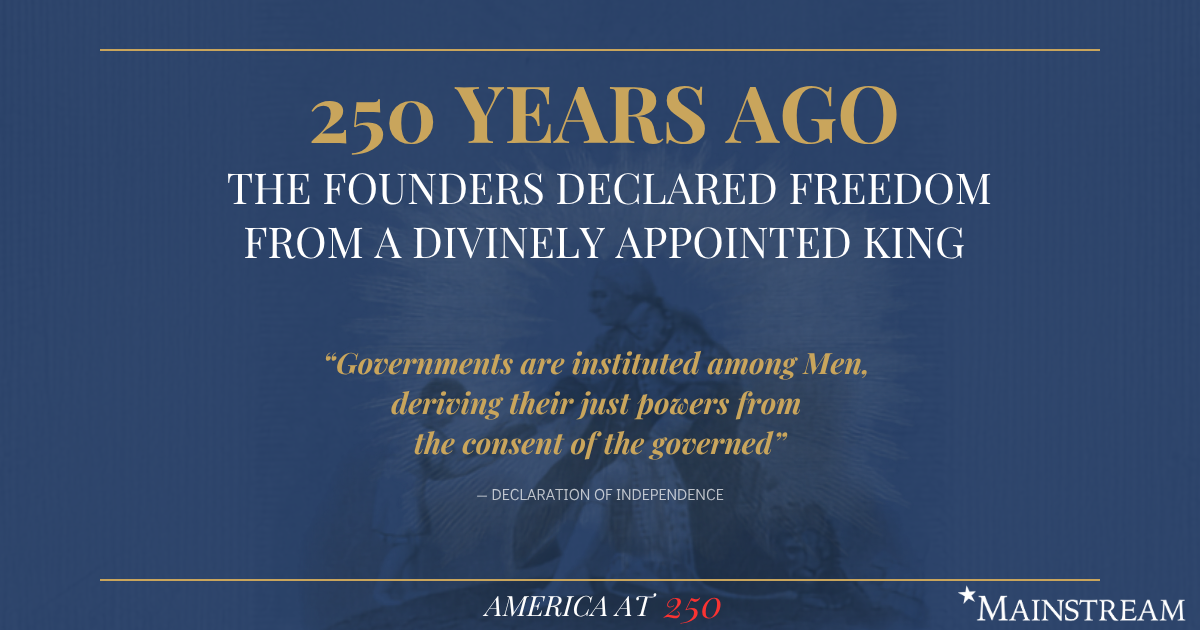
The power of American democracy comes from the people -- not from a divinely appointed king. 250 years ago the founders risked everything to declare our independence from an unjust leader: "A Prince whose character is thus marked by every act which may define a Tyrant, is unfit to be the ruler of a free people."
The Declaration of Independence used the language of enlightenment and faith, without ever naming or demanding obedience to a Christian God. The founders instead placed the power of the government into the hands of people: We the People.
Much like 250 years ago, we find ourselves in a time that demands action. We organize, rally, and advocate for policies that protect the rights and freedoms for all. We create the defense against those who would use their faith and their power as a weapon.
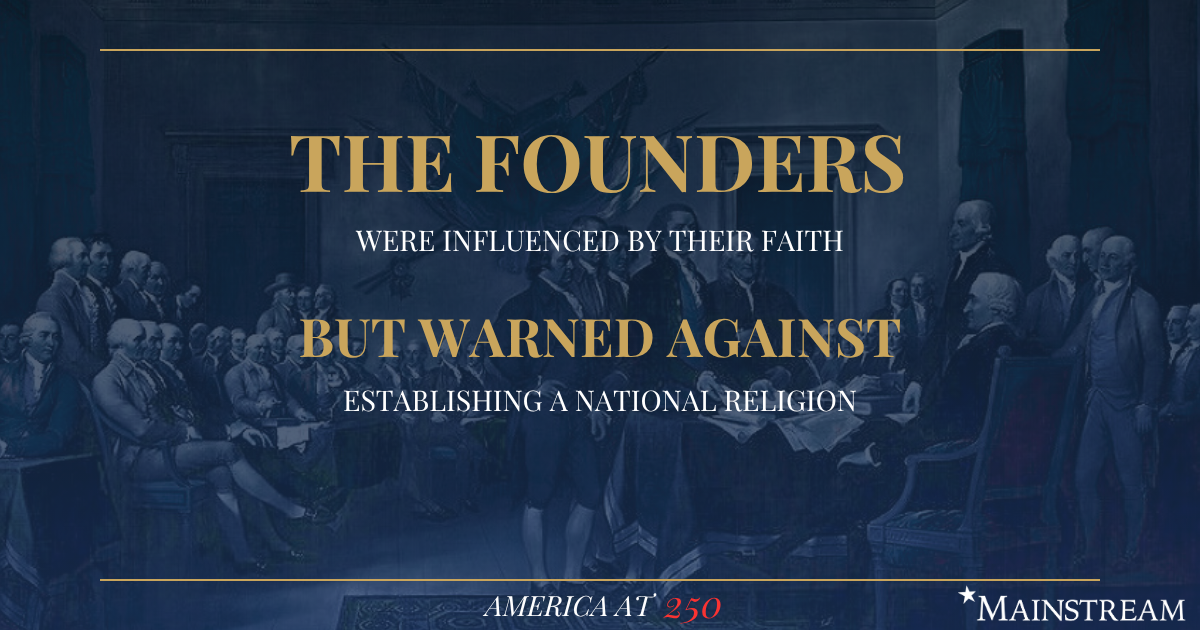
The Founding Fathers did not share a common faith tradition, and they were keenly aware of the dangers of establishing a national religion.
Some signers of the Declaration of Independence were devout Christians, such as Samuel Adams and Patrick Henry. Others, such as Thomas Jefferson and Benjamin Franklin, were Deists who believed in a God, but not necessarily in the divinity of Jesus. While the majority of the Founding Fathers were Protestant, others were religious minorities, such as Catholic and Quaker. The Declaration of Independence included broad language, like Creator and Providence, that could be understood by followers of multiple faiths.
The founders were influenced by their faith, much like politicians of today, but they took precautions to make sure all faiths were protected. In a precursor to the First Amendment, George Washington in his 1790 letter to the Hebrew Congregation in Newport, Rhode Island wrote of a new government that celebrated not just religious tolerance, but protected religious liberty.
The United States of America was founded by men and women who understood and welcomed religious diversity. Today, we continue to fight for these powerful protections of religious freedom for all against those who use Christian nationalism to exclude and cause harm.
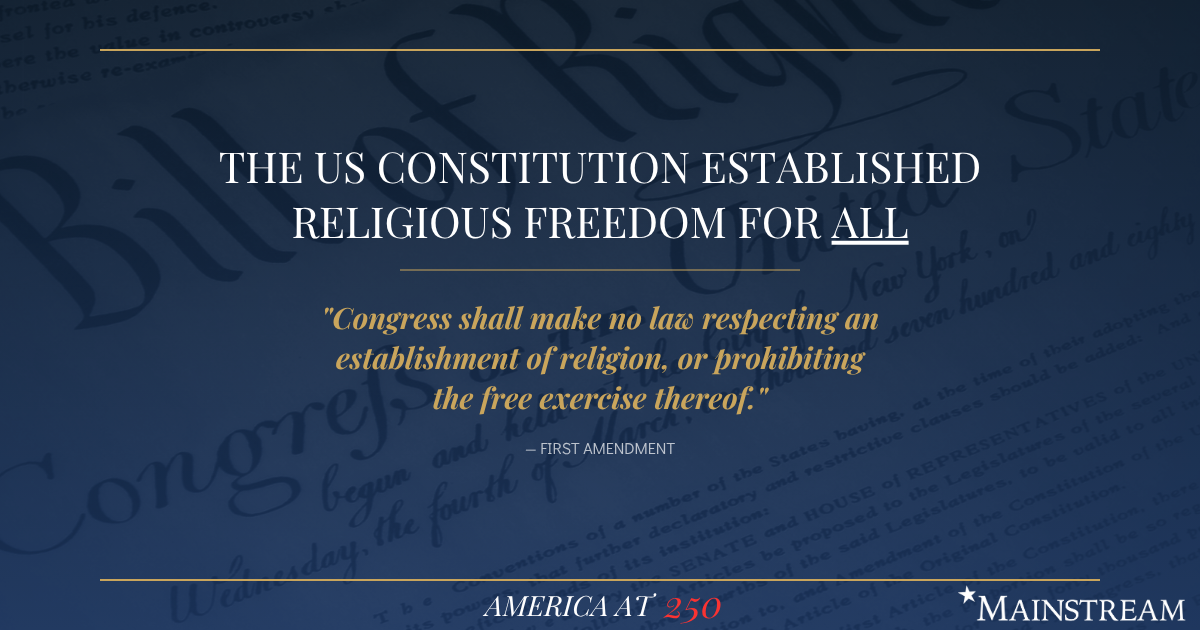
When the US Constitution and Bill of Rights were ratified over a decade after declaring our independence, they explicitly established protections for religious freedom.
First, under Article VI of the Constitution, no federal elected official or judge would ever be required to pass a religious test. In 1961, the Supreme Court ruled in Torcaso v. Watkins that states could not require someone holding public office to declare a "belief in the existence of God." People of all faiths, including secular non-believers, can serve in public office without adhering to any specific religion.
Then came the Bill of Rights: "Congress shall make no law respecting an establishment of religion, or prohibiting the free exercise thereof." Our First Amendment, while not directly using the famously cited "wall of separation" language of Thomas Jefferson, created religious liberty that protected all faiths and prevented a national religion.
Those who claim that the United States was founded as a Christian nation don't just ignore our history; they are re-writing it to promote an agenda that violates everything our founders stood for.
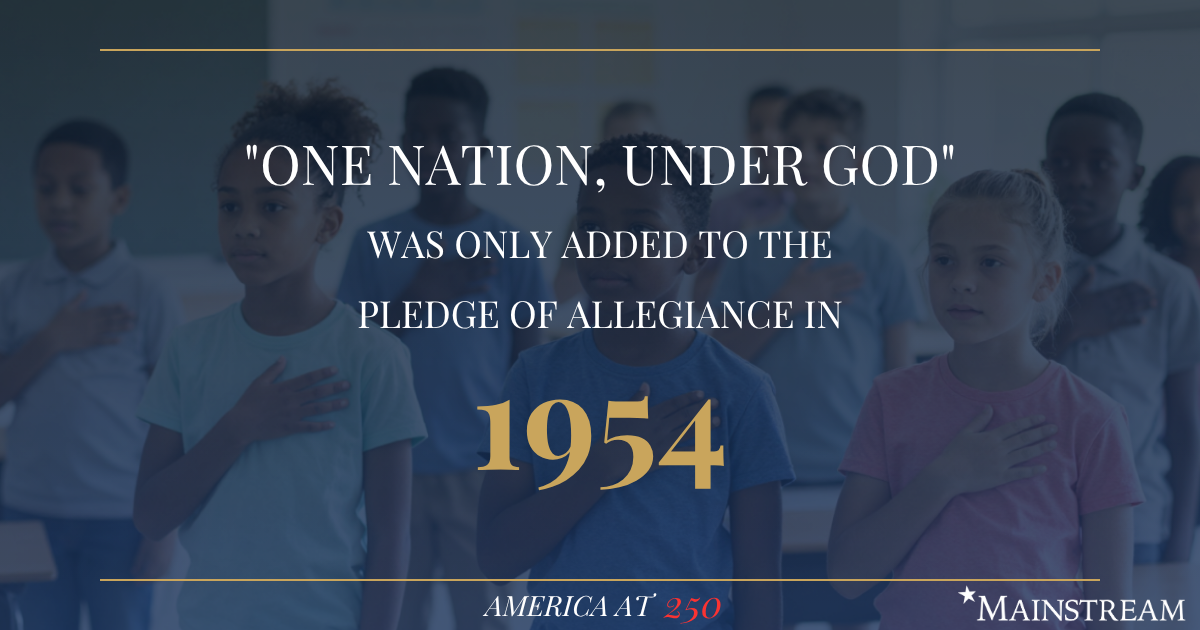
We are not experiencing the first time that Christian nationalists have tried to re-write our history. In the 1950s, America was in the middle of the second Red Scare and countered a communist Russia by embedding God into our patriotic traditions.
Beginning in 1954, Congress passed a law that inserted "under God" into the Pledge of Allegiance. The Supreme Court sidestepped the issue in the decades that followed, ultimately permitting the words "under God" to remain, despite multiple challenges to its constitutionality under the First Amendment. In written arguments, multiple Justices argued that "under God" in this instance is not religious, but a “patriotic ceremony.”
In 1956, the words "In God We Trust" became the official motto of the United States and began being printed on paper money. Like with the Pledge of Allegiance, courts have ruled the phrase to be "ceremonial deism" rather than any indication of a religious character.
When Christian nationalists point to these phrases as proof of a religious founding, they ignore a nuanced and complicated history that blends patriotism with broad religious language. The use of these words don't indicate a specific Christian country, but a reaction to geopolitical threats in the 1950s.
The United States of America is a promise unfulfilled. For 250 years, we have fought for a country that honors it's commitment to those inalienable rights -- life, liberty and the pursuit of happiness for everyone who calls it home.
The promise of religious freedom, not just tolerance but the welcoming of religious pluralism, is foundational to our history and to our future. Right now we're witnessing the Christian nationalist propaganda and pageantry of this Administration both in DC and at home in Kansas. But propaganda can't survive when faced with the truth.
Help Mainstream share our message on our Facebook and Instagram pages and become part of the movement to protect religious freedom for all here in Kansas with a donation to Mainstream.